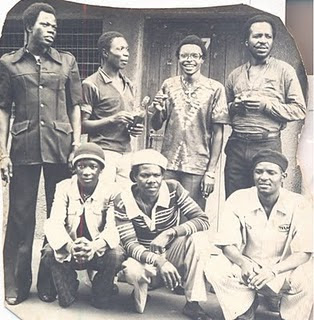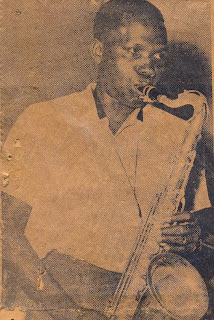
Ahmad Kipande was born in Kilwa. As a teenager in 1953, he decided to move to Dar es Salaam the capital city of the then Tanganyika to look for employment, when he arrived in Dar es Salaam life was not easy, but among things that he found very interesting was gramophone, this was an instrument that could play the 78 rpm shellac records. At the time the 78 rpm records from Cuba were very popular. The titles were in Spanish, but they were also numbered beginning with the letters GV, they were famously known as the GV series records. Ahmad began to listen and enjoy the music from these great Cuban masters, he also began to listen to musicians from East African Fundi Konde, Harry Makacha, Frank Humplink and his sisters and many other greats of the time. Gradually, he began to have the desire to become a musician. Kipande started teaching himself how to play various instruments by himself, in time he could play various instruments including the guitar, ukulele, banjo, and violin and finally he learned the saxophone the instrument that was to bring him great fame. Ahmad’s first music group was the Tanganyika Jazz Band. As was the mode in those days, the Tanganyika Jazz Band was a group of individuals who formed the band to play music as a hobby. The band consisted of guitars, violins, drums, trumpets and saxophones. In 1958 Ahmad decided to form his band, and the Kilwa Jazz Band was born. He bought all his instruments from the money he made working here and there, none of the instruments were electric, he even made his set of drums, using tin barrels and cow skin.
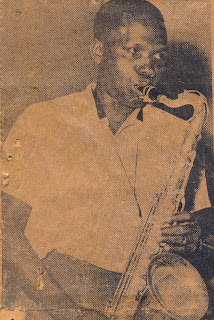
Among the first recruits of this band, there was Zuberi Makata whom he taught how to play the saxophone. Much later in the 90s, Makata was knocked by a car and died on the spot, as he had two wives leaving separately, it took several days before it was realized he was dead, each wife thought the husband must be at the other wife’s home.
The other recruits were Duncan Njilima a guitarist and Omari Omari. At that time other bands that existed in the city of Dar es Salaam and were trending were the Homeboys Jazz Band, Dar es Salaam Jazz Band, and Cuban Marimba Branch Band, which was a branch of the Cuban Marimba Band of Morogoro. The Morogoro Cuban Marimba band led by the late Salum Abdallah had many branches, for example, there was also the Cuban Marimba Branch of Kilosa.
Kilwa Jazz started playing music in various styles including rumba, samba, bolero, and chacha, imitating the Cuban bands. Kilwa Jazz Band soon became one of the most popular bands in Dar es Salaam. Ahmad Kipande and his Kilwa Jazz Band participated in many national events, one of the memorable was the Kilwa Jazz Band performance at the state house on 9th December 1961, the day Tanganyika got its Independence. And on that show, they sang a special song praising Tanganyika for getting Uhuru, but also lamenting for the other African countries that were still under the colonials. The rough English translation of the song goes this way;
“O Lord, we ask you,
Bless Tanganyika,
We have got freedom
But hearts are sad,
Our comrades are suffering,
The colonialists have still caught them in a web…”
Kilwa Jazz Band was a very respected band, it was sent by the Tanganyika government to participate in the Independence celebrations of Malawi and Uganda. One of Kilwa Jazz’s most popular songs was based on a phrase given by Mwalimu Nyerere in one of his many speeches, ‘It can be done, play your part’
Kilwa Jazz band had many songs that were loved and continue to be loved by even the young generation of music fans today, them there was a song called Kifo cha penzi (Death of love), in short, the composer says; “The death of love is a bad thing, never pray for the death of love”, and in the song, we are also reminded of two historical facts, one line says, ‘It’s better to die by being hit by a double-decker bus going to Ilala’, in those years public transport in Dar es Salaam used red double-decker buses. Another verse says ‘It’s better to die by being hit by a trailer truck going to Zambia’. At the time of apartheid South Africa, Zambia had to use the Dar es Salaam port and there were hundreds of trailer trucks carrying cargo and oil to Zambia.
Some of the many hits by Kilwa Jazz Band included Mapenzi yananivunja mgongo (Love is breaking my back), Kifo cha pesa (Death of Money), Dolly, Nacheka Cheka Kilwa leo (I am Laughing today), Vijana tujenge nchi (Young people let’s build our country), Rose wauwa (Rose you are killing me).
In 1973, Kilwa Jazz Band was invited to perform as a curtain raiser before the performance of the Rumba music legends, Franco and his T.P.OK Jazz at the National Stadium in Dar es Salaam.
Ahmed Kipande died on April 27, 1987, after a long illness. Kipande will continue to be remembered for the good music he left behind in this nation.
May Ahmad Kipande Rest in Eternal Peace.