
The new generation of Tanzanian musicians, particularly Bongo Flava artists, are famous for what are known as ‘beefs’. In Tanzanian music history, this phenomenon is not new; only the term is new. The beef culture in its own way, has always existed in Taarab music and also in urban ‘dansi’ music. The first Tanzanian bands were formed by ‘dancing clubs’. Some well-known early dancing clubs in Dar es Salaam and Tanga were the New Generation Dancing Club and the Novelty Dancing Club. Early bands had names like the YMCA Social Orchestra and the Dar es Salaam Social Orchestra. This culture of bands being formed by social clubs which had rivalry between themselves, introduced the first rivalries among music groups. Club members would be staunch fans of their club’s music groups.
For a period in the sixties, the city music of Dar es Salaam in the realm of rumba bands was dominated by two bands: Dar es Salaam Jazz aka Majini wa Bahari (Spirits from the sea) with their Mundo style, and on the other side, Kilwa Jazz Band. It was a fierce rivalry that even led to fans of these two bands clashing violently. The bands composed cryptic songs targeting each other; one famous one was the Dar es Salaam Jazz song “Mali ya mwenzio siyo mali yako,” (Another’s property is never yours) mocking Kilwa Jazz due to the tax ambiguity surrounding their club’s location.
In Morogoro, there were two giants: Morogoro Jazz Band and Cuban Marimba Jazz Band. Their rivalry ignited passion across all of East Africa; people would strive to be in Morogoro on weekends. Morogoro Jazz Band went through different styles including Likembe, Mahoka and Sululu style, while Cuban Marimba had the Subi subi and Ambianse style. They too composed many cryptic songs targeting each other, the songs which excited their fans
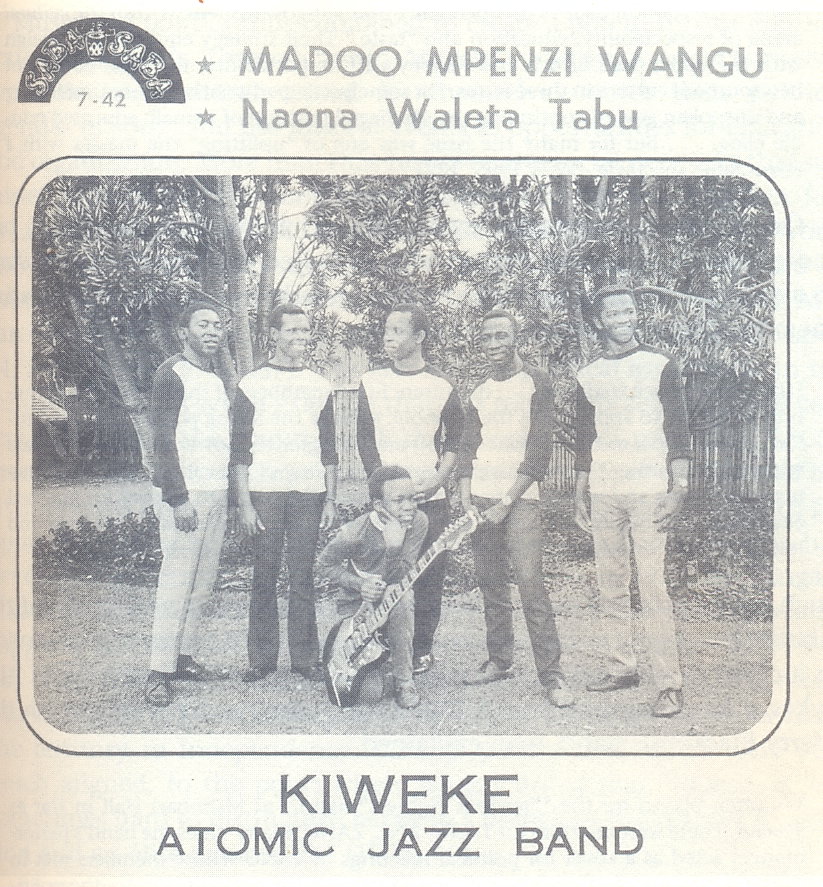
In Tanga, there were the youths of Barabara ya 4 (The 4th Road), Atomic Jazz Band with their Kiweke style, competing against Jamhuri Jazz Band and their many styles like Dondola and Toyota. This rivalry existed in many bands throughout the country for many years, there was the ever present rivalry between Msondo and Sikinde, these two are styles of two bands. Msondo is the style of the band that was created in 1964. The band began as NUTA Jazz Band, it was owned by the works union, NUTA, when NUTA changed its name to JUWATA, the band became JUWATA Jazz Band and when the workers organisation became Organisation of Tanzania Trade Unions (OTTU), the band was renamed OTTU Jazz Band, finaly when OTTU was dismantled, the band went on to be owned by the musician and named itself Msondo Music Band to date.
Sikinde is the style of its rival band, Mlimani Park Orchestra. The band began its life in 1978, it was owned by a parastatal organisation known as Tanzania Tourists and Taxi Services (TTTS). Because of the to and fro shifting of musicians between these two bands, the rivalry has always been there with fans from both sides claiming their band is the best. There was another rivalry that was more perceived than real, as many thought, between Vijana Jazz Band and Washirika Tanzania Stars Band, to the extent that at one point the song “Nimekusamehe lakini sitokusahau” which could be translated like I have forgiven you but I will not forget, was interpreted as having been composed by Hamza Kalala of then Washirika Tanzania Stars Band, to send a message to Hemed Maneti the band leader of Vijana Jazz Ban. Hamza with whom I recently spoke about the song, said he never composed the song with Maneti in mind.
Music fans during the heyday of Orchestra Maquis Du Zaire and Orchestra Safari Sound, remember the great rivalry that existed between these two bands, which at one time both had their headquarters not too far from each other, Maquis du Zaire in Ubungo while Safari Sound in Kimara. When Maquis established their Ogelea piga mbizi style roughly translated, Swim and dive , Safari Sound came up with Chunusi style. Chunusi is a spirit believed to live in water and can drown you.
Throughout this entire flow of rivalry, it rarely reached the point of individual musicians physically fighting due to competitive reasons. And the rivalry was meaningful because, each band tried to come up with better music that its rival, the standars of music rose to new heights. And every band wanted to be unique. Jamhuri Jazz Band and Atomic Jazz band were both from Tanga, but each had distinct music, and similarly with Morogoro Jazz Band and Cuban Marimba Band of Morogoro town, or Tabora Jazz Band and Nyanyembe Jazz Band both from Tabora town.
In the 80s, every Tuesday morning, Radio Tanzania Dar es Salaam had a program that aired the latest songs recorded in its studio, the program was named Misakato. It was not uncommon to find musicians from a rival band listening to their competitors’ new songs. They would even give credit where it was due. I remember when Tancut Almasi Orchestra we were once in Morogoro where we had been hired by a colleg to perform at the graduation ceremony. Vijana Jazz Band’s new songs were being aired for the first time on the Misakato program. We all gathered around the radio to listen to their work because, at that time, Shaaban ‘Wanted’ Yohana our lead guitarist had just left us to join Vijana Jazz Band, we wanted to hear what had he come up with. After the program we sat down and even revised some songs we felt were below Vijana’s standard; the result was that our next album came up with hits like Helena Mtoto wa Arusha, Masikitiko, and others. Songs that are still aired today more than 35nyears after we recorded them.



I have to correct you on two points.
1) Mali ya mwenzio sio mali yako was a song by Western Jazz. I still have the 45 vinyl. Rashid Hanzuruni played solo guitar. As a young boy, I saw them live playing this song.
2) There was no rilvary or animosity between Tabora Jazz and Nyanyembe. In actual fact, before they acquired instruments for Nyenyembe, they were playing together in the same hall(old Lumumba) which still belong to my family! And Rashid Hanzuruni was the first Nyanyembe soloist( after he had recovered from sickness when he came back from Western Jazz! Shamba and others followed later.
THANK YOU SIR FOR THE INFORMATION. ALTHOUGH I HAVE AN AUDIO INTERVIEW BY ONE OF THE FORMER MEMBER OF NYANYMBE AND HE SAID IN THE INTERVIEW BOTH BANDS WERE UNDER THE SAME OWNER. NYANYEMBE WAS TAKEN AS TABORA JAZZ B.
That’s correct. The owners at that time were Mzee Mlekwa and Mzee Songo. These were the main administrators of the band. There were aother shareholders -Mzee Jumanne Kombo, Mzee Isa Kibira and others(I have forgotten their names). These were all Manyema elders. Tabora Jazz B became Nyanyembe to accomodate Rashid Hanzuruni. Tutaongea nikija maana hao wote ni wazee wangu na nitakupa story yote ya Tabora Jazz toka 1964 mpaka 1972!
Thanks very much for the information
That’s correct. The owners at that time were Mzee Mlekwa and Mzee Songo. These were the main administrators of the band. There were aother shareholders -Mzee Jumanne Kombo, Mzee Isa Kibira and others(I have forgotten their names). These were all Manyema elders. Tabora Jazz B became Nyanyembe to accomodate Rashid Hanzuruni. Tutaongea nikija maana hao wote ni wazee wangu na nitakupa story yote ya Tabora Jazz toka 1964 mpaka 1972!