
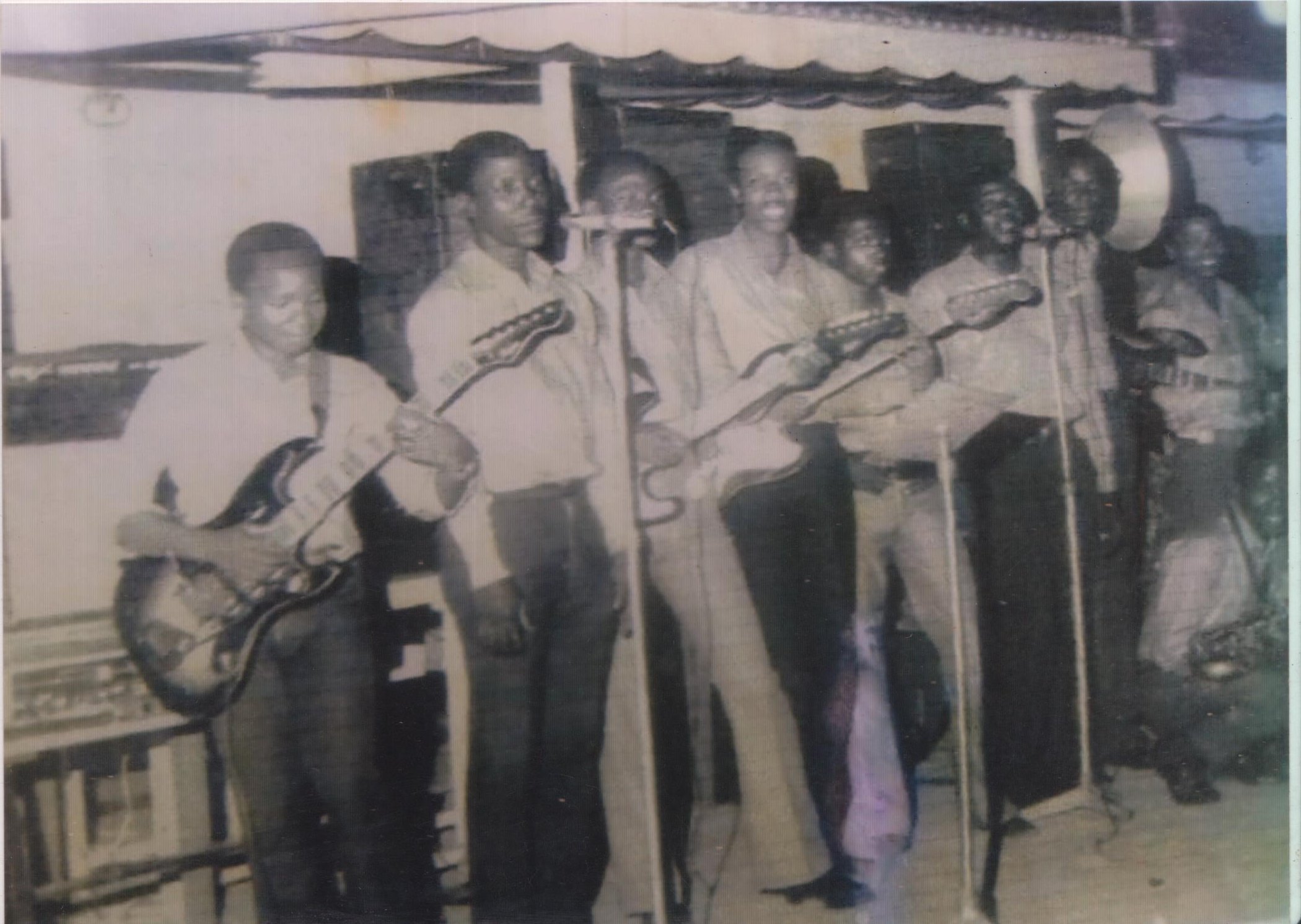
In the original African rumba music arrangement, particularly from the 1950s onwards, bands employed a system of three guitars, which were designated as the solo guitar, rhythm guitar, and bass guitar. The solo guitar had a high tone, the rhythm guitar had a slightly heavier mid-range tone, and finally, the bass guitar had a heavier tone than the other guitars. In terms of structure, there is no difference between the rhythm guitar and the solo guitar. Both have six strings, but in tuning the amplifier, the rhythm guitar’s treble (sharpness) is somewhat reduced, and more bass is added compared to the solo guitar, which typically has more treble than the other guitars. In the early 1960s, a fourth guitar began to be used, known as the ‘second solo’ or called ‘mi solo’ by the Congolese. It is said that the brother of the famous Congolese solo guitarist of that era, Dr Nico, Charles Mwamba, popularly known as Dechaud, was the one who introduced the style of adding a fourth guitar. This guitar was played in various ways by different bands. Some bands used the second solo guitar as a guitar that responded to the solo guitar. I remember the late Ally Makunguru, a famous rhythm guitarist, used to say the solo guitar and second solo guitar should argue like a husband and wife. In the arrangement of other bands, the second solo guitar responded to the rhythm guitar, while in others, it played the harmony of the solo guitar or sometimes the rhythm guitar. The Cuban Marimba Band under Juma Kilaza added innovation by including a fifth guitar and calling it the ‘chord guitar’; listening to the arrangement of guitars in his songs is very enjoyable. This innovation greatly enhanced the weight of the music and even brought various flavours to dance music. And the decision on the type of guitar arrangement made a huge difference between the music of one band and another.
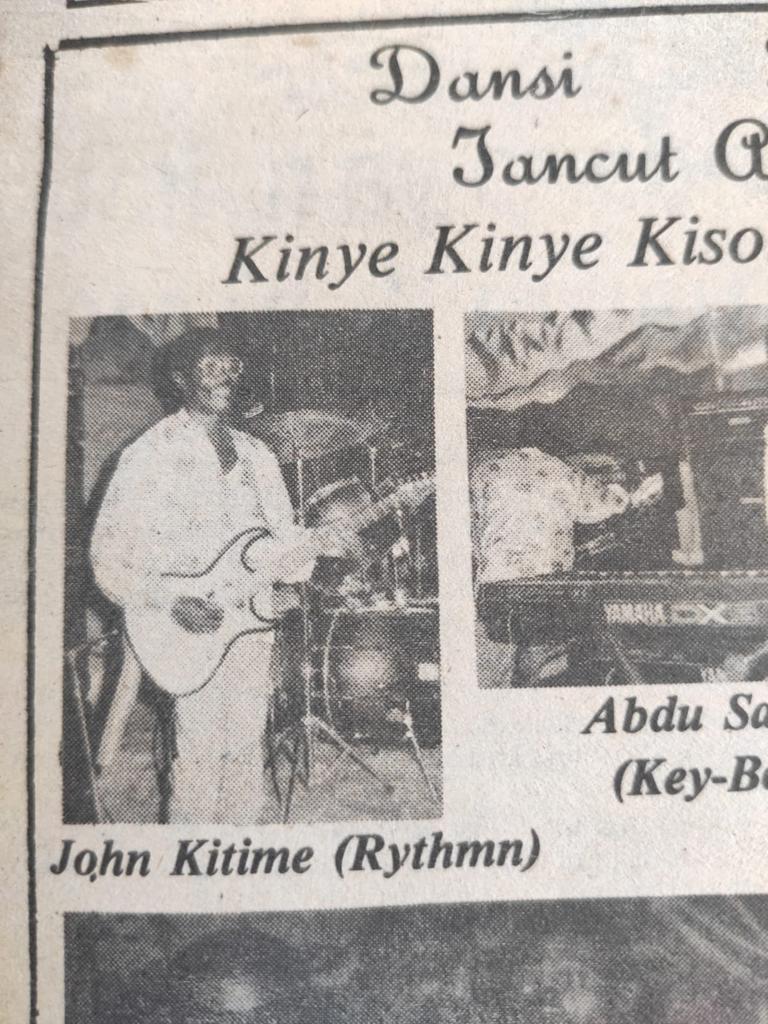
But in today’s article, let’s talk about the rhythm guitar. This instrument is still played in some bands, but its importance has greatly diminished. In the 1960s and 1970s, this guitar held great importance, and its players developed their own styles and built significant reputations. Among the famous rhythm guitarists was Satchmo, the stage name of Harrison Siwale, a Zambian who settled in the city of Tanga. He was a member of major Tanga bands, including the Atomic Jazz Band, and eventually the Jamhuri Jazz Band. Satchmo had his own unique style of playing rhythm; I don’t recall hearing anyone else playing rhythm guitar in his way before, but certainly many rhythm guitarists adopted his style and developed their own variations. His skill in playing rhythm guitar dominated the songs of Jamhuri Jazz Band at that time. His craftsmanship is very evident in songs like Mganga No. 1 and 2, or Blandina, where, as per the old practice, there was a phase when the rhythm guitar was left to play alone, a style that music lovers greatly enjoyed.
In Tabora, Kasim Kaluwona also had a distinct rhythm guitar playing style that gave Tabora Jazz its unique flavor; they called it Segere Matata. You can hear Kasimu Kaluwona’s guitar playing in songs like Dada Asha or Dada Lemmy, two songs which were later re-recorded by Soukous Stars in their collection of ‘Nairobi Nights’.
Charles Ray Kasembe entered the world of big band music in Tanzania after being brought to Morogoro by Juma Kilaza’s Cuban Marimba Band. While in Morogoro, he crossed over to the Morogoro Jazz Band led by Mbaraka Mwinshehe. His rhythm guitar playing is heard well in songs like Wajomba wamechacha. These are a few of the rhythm guitarists who left a mark with their work.
In the late 1960s, a new method of stringing the rhythm guitar was introduced. Rhythm guitarists removed the fourth string from the guitar and replaced it with the first string, resulting in two first strings on one guitar. Musicians in Tanzania called this arrangement ‘Double String’. It was during this era that artists like Vata Mombasa were able to bring a new sweetness to rhythm playing. At the same time, Orchestra Kiam came up with the style of playing the rhythm guitar with ‘Double String’ but at very high speed; songs like Kamiki and Bomoto are evidence of that work.
As I mentioned earlier, the importance of the rhythm guitar was evident in many bands through the style of ‘leaving the rhythm’, which was an arrangement where, in the middle of the song, the rhythm guitar was left to play alone while the other guitars were silent, perhaps accompanied by some cues from the bass guitar. There, the rhythm guitarist was free to play as he wished and showcase all his skills. This style was greatly loved by music enthusiasts. This practice has returned in a very surprising way; many Taarab bands have revived the ‘leaving the rhythm’ style, but since those bands no longer use a rhythm guitar, this role is performed by the solo guitarists or the keyboardist, and often the same phrases played by the old rhythm guitarists in dance music are replayed!!!
The strange thing is that the result is the same; music enthusiasts get excited and dance a lot during that phase.
Currently, many dance bands no longer place importance on the rhythm guitar. The keyboard has taken the place of this guitar. There are a few bands that still have a rhythm guitar, but in these times, vocalists are more important than musical instruments, so you might see a rhythm guitarist on stage but would hardly hear what he is playing.
Farewell, rhythm guitar.



What a sad times for the beauty in music. The keyboard can not really bring that richness found in the ryth mguitar.