
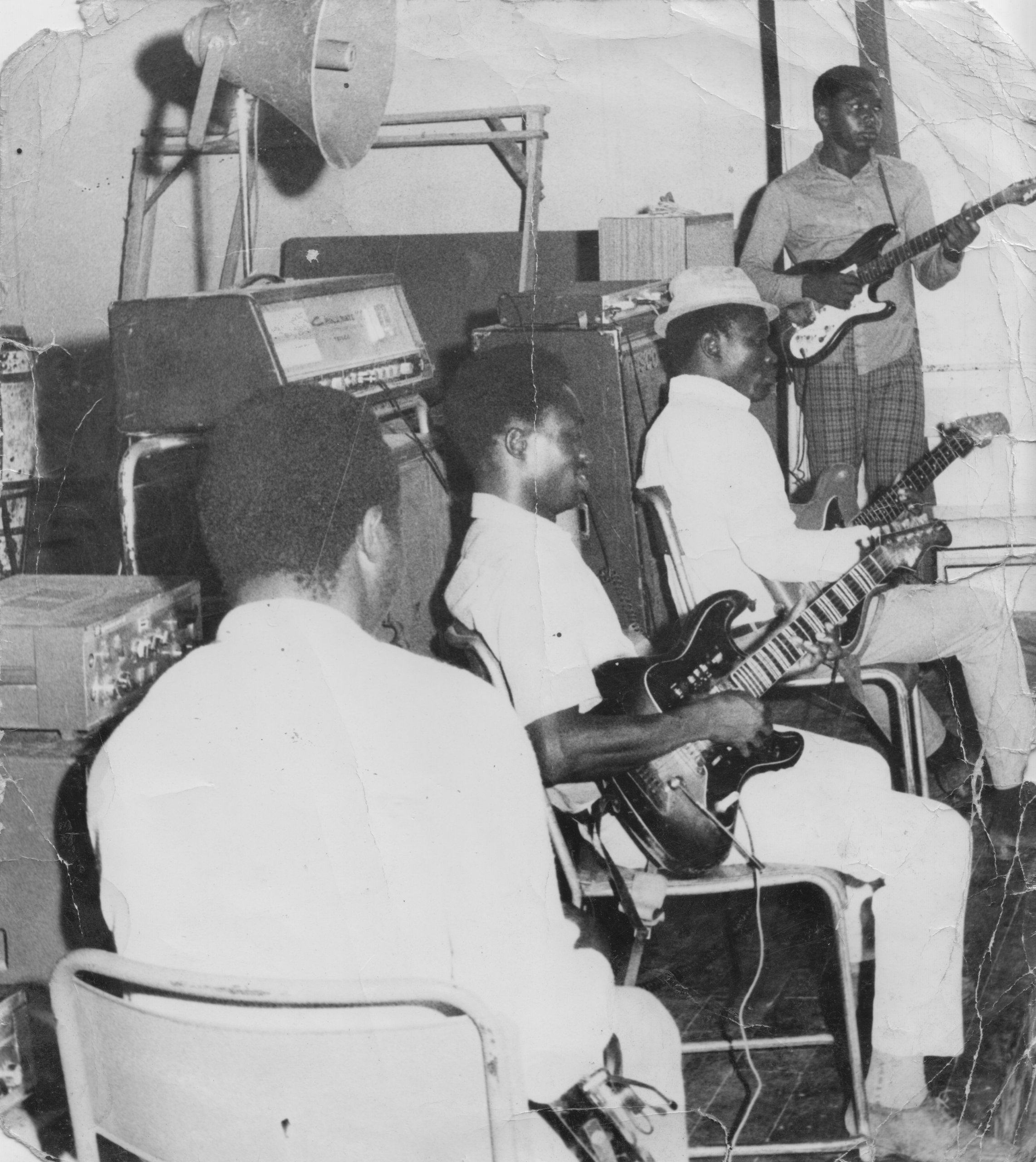
The Tanzanian rumba music between the 1960s and 1990s, bands had a system of using three or four guitars. There was a lead guitar known as the solo guitar, then there was a supporting guitar called the rhythm guitar, and there was also a heavy guitar known as the bass guitar, and finally, there was a guitar that was between the solo guitar and the rhythm guitar, which was called the second solo. Others used the Congolese name *Mi solo*.
All these guitars ended up being played by famous players, who could produce sounds that greatly entertained music lovers in those eras and still do today. However, if you go back to the past, especially the years between the 1940s and 1960s, before the solo guitar became the lead instrument, the Mandolin and Banjo held that position of leading the music. The Mandolin was a type of small guitar with eight strings; the banjo was also a stringed instrument that had five strings.
Today, I will talk about a few of the many solo guitarists. Between 1957 and 1960, the electric guitar began gaining popularity among popular bands. The Dar es Salaam Jazz Band was among the first bands to own an electric guitar. It is said that one musician, who is mentioned as a Msukuma man named Haus Dibonde, was the first electric lead/solo guitarist. He was originally a musician with the Dar es Salaam Jazz Band, then he was poached by the Western Jazz Band; unfortunately, he later developed mental problems and had to be sent back home.
In the early years, lead/solo guitarists were very scarce, to the extent that they alone were guaranteed a salary at the end of the month. All other guitar players were paid a small allowance after the end of every show. Some of these guitarists even demanded they be the Band leaders as an incentive to join a band.
That is why in many bands, their Band Leaders were also the solo guitarists. Giving leadership to solo guitarists ensured that a band would not have its lead guitarist poached. But unfortunately, not all soloists had the ability to lead a band; many bands died due to the poor leadership of a skilled solo guitarist.
Although many solo guitarists gained great fame, many were not lucky enough to become known. But they all certainly contributed greatly in one way or another in raising the flags of their bands. It was easy to distinguish one band from another just by the playing of the solo guitar.
Here are stories of some soloists who managed to gain fame. Let me start with Rashid Hanzuruni. He played the guitar in many bands in the country, including Kimbo Twist Band of Mwanza, Tabora Jazz Band, Dodoma Jazz Band, Kilwa Jazz Band, and Western Jazz Band. His skill in his time was compared to the famous Congolese guitarist Nicholaus Kasanda better known as Dr. Nico. Hanzuruni was certainly a master; he was also the first known Hawaiian guitar player. The Hawaiian guitar was played by sliding a metal bar over the guitar strings, and was usually placed on a table while playing. Unfortunately to Hanzuruni, as did happen to Haus Dibonde, developed mental problems. In those times, there were stories that it was the result of witchcraft performed by those who were jealous of his skill.

Another master of the solo guitar was Michael Enoch Chinkumba, later known as King Enoch and sometimes as Teacher. Michael Enoch came from Zambia; he was brought to the country by a famous politician from Mbeya named John Mwakangale. Mwakangale had a band called Free Mwakangale Jazz; he went to Zambia to buy musical instruments, where he met Michael Enoch and three of his friends and persuaded them to move to Mbeya to play for his band. Michael Enoch played for that band, and after many ups and downs( a very interesting story coming sometime), he landed at Dar es Salaam Jazz Band, which was looking for a soloist to fill the gap left by Haus Dibonde.
Michael Enoch made a huge contribution to solo playing; he was very well known for his ability to use guitar effects in particular the tremolo, the echo chamber and the repeater which made the sound of his of Dar es Salaam Jazz Band unique.
Among solo guitar players, you just cannot fail to mention Mbaraka Mwinshehe. He started by playing the flute; he would escape from school at night to go play the flute for the Morogoro Jazz Band. One day, he was discovered to be among students who were escaping from the dormitories at night. He and the other escapees were ordered to be caned. Mbaraka decided to leave school rather than be caned. After that, he ended up joining Morogoro Jazz Band as a flute player, but after a short time he showed great talent for playing the rhythm guitar. The band leadership decided to hire him as a rythm guitarist and his salary was set at 125 shillings per month. This greatly annoyed the lead guitarist who he felt he was the only one entitled to a salary. To complicate the matter, a few days later, the lead guitarist refused to travel with the band to Dar es Salaam, where the band had been invited to a band competition. A common practise then. Mbaraka was forced to play the lead guitar and didi a fantastic job, his salary was raised to 250 shillings; and became the official solo guitarist of Morogoro Jazz Band . What happened after is now history.
In the sixties, there was a band in almost every town in Tanzania. And of course every band had a solo guitarist, there were thus hundreds of solo guitarists. It is not easy to name them, but from one small town called Kilosa came a musician whose was Abel Balthazar. Abel was a multi instrumentalist, apart from being a lead guitarist, he could also play the saxophone very well. Abel’s history is long and very interesting; besides music, he also had a great talent for planning, which enabled him establishment a number of bands most of which became the top bands in Tanzania.
Before gaining fame, some of the bands Balthazar passed through were; Highland Stars Band, a band based in Iringa town. Balthazar worked in this band but never recorded with the Highland Stars Band in Iringa, then Balthazar went to the Kilosa Jazz Band and became a very reliable player. While at Kilosa Jazz Band, he was persuaded to join Dodoma Jazz Band. He left Kilosa Jazz Band for Dodoma Jazz Band, where he was welcomed with two arms, and rehearsals began. He was also sent to a tailor to get a three piece suit sewn for him. One day during the rehearsals, three elders came and announced they had been sent from Kilosa Jazz Band to deliver a letter to the leadership of Dodoma Jazz Band. They handed the letter to the leader of the Dodoma Jazz Band, the letter demanded that Balthazar return to Kilosa Jazz Band immediately; otherwise, serious consequences would occur. In those days, a threat like that was not taken lightly. Without wanting to wait for the outcome, Balthazar was sent back to Kilosa Jazz Band.
One day Balthazar reached the decision to escape. That day, Kilosa Jazz Band was playing at the Community Center hall. Kilosa was a big train station, it was about eleven at night, the train whistle was heard, signaling that the train from Mwanza to Dar es Salaam was entering Kilosa. Balthazar did something that was common in those years; in the middle of a song, he left the rhythm guitarist to continue playing alone, it was a style of musical arrangement in those days, where only the rythm guitar continues playing, the lead and bass guitar pause for some minutes. Balthazar put down his guitar and stepped off the stage as if going for a short call. While people continued dancing, Balthazar pwent straight to board the train and that was how he left Kilosa Jazz Band.
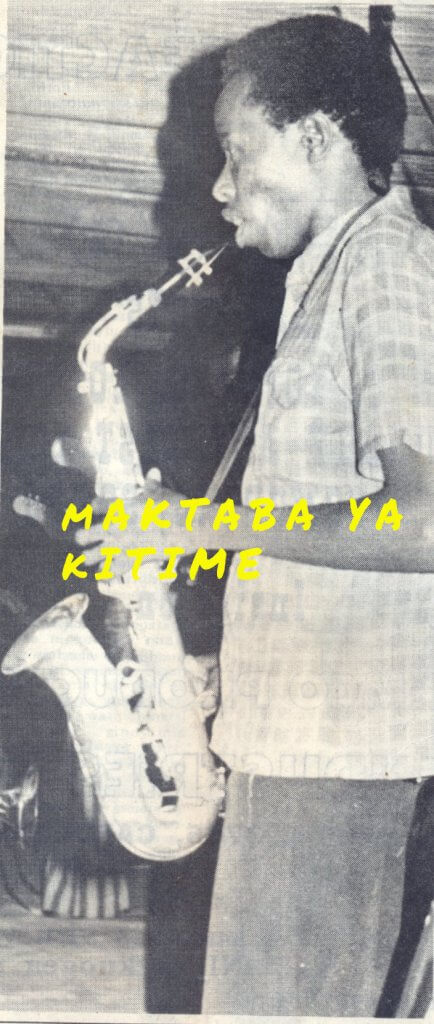
Balthazar resurfaced as amember of the great NUTA Jazz Band. While with NUTA Jazz Band, Balthazar’s star rose, he recorded songs that still touch the hearts of Tanzanian dance music fans to this day since those days in the 70s. Balthazar continued to be a member of top bands in the country, such as JUWATA, Dar es Salaam International Orchestra, Mlimani Park Orchestra, International Orchestra Safari Sound, and finally Magereza Jazz Band, where he passed away.
Another band that had a number of very skilled lead guitarists was the Western Jazz Band. Western Jazz Band gave itself that name because its founder was from the Western Province. During British rule, Tanzania was divided into provinces, one of the provinces was named Western Province The province covered what are now Kigoma and Tabora Regions. Iddi Nhende, the founder of Western Jazz Band, was a native of Nzega, then just a small town in the Western Province.
During its existence, this band always had very famous solo guitarists. Starting with Hausi Dibonde, the first electric guitarist in dance music bands, a player whom Western Jazz poached from Dar es Salaam Jazz Band. They also later had Rashid Hanzuruni, Shamba Ramadhani, and Wema Abdallah. All these famous players recorded with Western Jazz Band songs that shook the airwaves of East African music. Only Dibonde did not get to record with the Western Jazz Band. The style of this band was called Saboso, although fans of that style shortened it to simply Boso
In the city of Tanga, there were several famous bands such as New Star Band, Amboni Jazz Band, Jamhuri Jazz Band, and Atomic Jazz Band. These bands were able to produce very famous soloists.Jamhuri Jazz Band, which started as a group called Young Nyamwezi Band in 1955, came to change its name a few years after Tanzania became a Republic (Jamhuri). One of the famous Jamhuri Jazz Band’s lead guitarist was Issa Bendera, who began playing the lead guitar during the days with Morogoro Jazz Band, then collaborating with Mbaraka Mwinshehe. In Jamhuri Jazz Band Issa collaborated with Hassan Rajabu on the lead guitar, who before joining Jamhuri Jazz Band was with Amboni Jazz Band, a band that gained fame for their hit song Kidomidomi.One important thing it should be noted, each of these solo guitarists,was able to invent come up with their own style of playing to the extent that every band had its own kind of taste, and they took pride in that difference.
The Tanzania China Friendship Textile Mill, which was built by the Chinese and given the name Friendship to show the friendship between Tanzania and China, was known locally as Kiwanda cha Nguo cha Urafiki. As was common with many parastatal and government institutions at that time, in 1970, Friendship Textile Mills started a band and named it Urafiki Jazz Band. The solo guitarist of this band was named Michael Vincent Semgumi. He came from the African Quelado Jazz Band, as did several of his peers who joined that band. This musician’s guitar playing was very unique; he liked to use a sound effect called a Repeater. First, he was a skilled player, and that repeater made his playing absolutely unique. It is hard to find anyone who has developed the skill of Michael Vincent.
In the past, some bands used to advertise jobs in newspapers. Biashara Jazz Band under Juma Ubao (King Makusa) advertised a position for one guitarist and one keyboard player. I went to try to get the job as a guitarist; several other musicians also showed up. Before starting the audition to show our guitar playing ability, King Makusa took a guitar and strummed it, his fingers dancing on the strings at a very high speed, immediately I decided that I would not introduce myself as a guitarist. At that time, I was playing in a band called The Oshekas, and I was playing keyboard on some songs. I wasn’t very good, but that’s how it was. I changed course right there and asked for the keyboard job. King Makusa turned on the keyboard and played it with great skill. I asked for permission to go relieve myself; when I returned, I had changed my job again and called myself a singer. I remember that same day we started practicing a song called Betty; when we finished practice, I never went back, the standards were too high for me. establishment
Juma Ubao, aka King Makusa, was the leader of Biashara Jazz Band, a band established after the of the Board of Internal Trade (BIT), which managed Regional Trade Corporations (RTCs), a system rand the death toll for the State Trading Corporations (STC). During the STC era, there was a band named STC Jazz Band that had great musician; Marijani Rajabu, Raphael Sabuni, Belino, Ally Yahaya and others. Withe the death od STC corporation and the STC Jazz Band was disbanded, and the Biashara Jazz Band was born. The new band was a mixture of some musicians from STC Jazz Band and new names like Juma Ubao, Ulembo, Huluka, Ally Jamwaka, and others. The solo guitar was the domain of Juma Ubao, it was of its own kind. He himself was tall with long fingers that had speed, and he had his own unique style of playing guitar that intimidated other players of his era… something like Jimi Hendrix playing the rumba….
TO BE CONTINUED



Most interesting narration. For those of us who were there in sixties and seventies, your story takes us down the memory lane.
During my A-Levels at Mkwawa High, I had a chance to attend a performance by STC Jazz when the band came to stage shows in Iringa. I felt privileged to be at a music show whose band leader was my homeboy Raphael Sabuni. Mkwawa Jazz (Wana Ligija) under Sewando curtain raised the show.