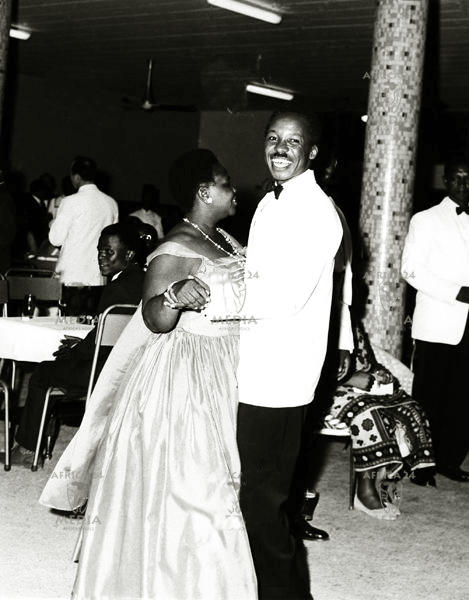
I started playing in a band in 1975. At that time, I was a teacher in Iringa, and a few of my friends and I formed a band. We had only two guitars and an old drum set, which consisted of a snare drum wrapped in cowhide and a bass drum without a foot pedal, so it required two people to play. We called our band Chikwala Chikwala Band. That name was coined by one of the musicians, Mamado, who was also a watch repairer. I still don’t know the meaning of the name, but it followed the trend for bands to have repeating names, imitating the Congolese bands like Orchestra Bella Bella or Orchestra Lipua Lipua, and so on. Our small band used to tour villages around the town of Iringa. Fertiliser warehouses also served as the dance halls, and eventually we would sleep right there after the dance, covering ourselves with empty fertilizer sacks. Funny thing is that my old friends still identify me as Chikwala chikwala musician after all these years
To this day, I cannot remember how many musical tours I have undertaken here in Tanzania throughout my music career. However, certainly there is not a single district, among all the districts that existed in Mainland Tanzania between 1982 and 1992, that I did not visit to perform a music show.
Let me tell you about some of the journeys I remember. I will start with the tour around the Lake Zone, when I was one of the musicians of the Tancut Almasi Orchestra, a band whose base was in Iringa, in the late 80s. This band belonged to the workers of the Tanzania Diamond Cutting Company.
An agent for a famous businessman from Mwanza came to Iringa to arrange for the band to tour the Lake Zone. The band was ready for that tour, but it had a contract to go perform one show at the graduation ceremony of IDM College in Morogoro. After that, the band would be able to head to Mwanza to start the Lake Zone tour.
After the IDM show, that very night we went to the Morogoro train station to try and board the train coming from Dar es Salaam heading to Mwanza. Unfortunately, we missed the train by just a few minutes. The agent managed to find a small truck that same night. Musicians, dancers, technicians, the agent and our music instruments we were all packed into the small truck. The plan was to travel that night to Dodoma to catch up with the train that had passed Morogoro. That plan failed because of the weight of the equipment and people; we had four punctures, not even halfway to Dodoma. So, instead of arriving in Dodoma at dawn, we entered Dodoma at 2 PM, very tired. The agent managed to get a nice place for the musicians to eat and rest, and he even managed to get train tickets to Mwanza for the next day. Shoni, the band manager and I were given the task of transporting the music instruments. We went to the train station and managed to complete all the procedures, and the instruments were packed into cargo wagons, ready to leave anytime. The Railway Corporation management assured us that the instruments would be shipped by a goods train that same day. Since goods trains didn’t have a fixed schedule, the two of us were forced to stay at the train station ready to leave at a moment’s notice. We spent the whole night there until morning. Our colleagues found us there the next day when they were boarding the passenger train for Mwanza.
We spent that whole day there, several goods trains arrived and departed, and several cargo wagons that were there were coupled and left, but our wagon was not coupled. When we asked the reason, we were told our cargo wagon had problems with its brake pipes. We stayed there throughout that day, and the second night came while we were still there. We suspected we were going to spend the second night there, getting bitten by mosquitoes and suffering from Dodoma’s severe cold. At around midnight, one of the railway workers startled us by saying if we didn’t watch out, we could even spend a whole week there. We should look for the person in charge and give him a little money, and brake pads would be found. And indeed, after giving some money to some guy, the brake pads were found to have miraculously healed. Our wagon was coupled to a goods train, and the journey began. Since it was a goods train, my colleague and I got into the locomotive. We paid the fare to the train driver. For the first time, I was able to see how a train driver operates a train. The journey was fine, except every time we approached a station, we were forced to go into the engine area to hide because the driver was not allowed to carry passengers. Honestly, inside that engine area was very scary, there was a small iron door to the left of the driver, we entered by bending down, and inside it was full of pipes of every size, it was noisy, dark and extremely hot.
We arrived in Mwanza around 11 AM, and that day was the Eid holiday. The band had already advertised that it would perform an afternoon gig at the Kirumba Stadium, and at night, the band would play at the Shinyanga Hotel hall. For us, it was from the train straight to Kirumba Stadium. The Kirumba show went well and ended at 6 PM. The instruments were moved and taken to the Shinyanga Hotel hall, where another show started at 9 PM. Just as we started the show, a person appeared with a video camera and began recording the show. The show stopped, and a big argument ensued to stop the videographer because he had not asked for our permission. Eventually, he was allowed to video us after paying us thirteen thousand shillings. We shared the money, we were a big band, and I remember getting five hundred shillings.
After performing several shows in different halls in Mwanza, including the Mwanza Police Mess and the famous Pamba House hall, the band went to perform in Tarime. The band was transported by a bus belonging to the man who had hired the band. The Tarime show was not very successful, and we also had another incident where two of our band members were arrested by the police for smoking marijuana.
Immediately after finishing the Tarime show, the journey back to Mwanza began. Some of the musicians had built a friendship with the bus conductor, who tipped his friends that a plan had been hatched to abandon the band at the main bus station in Mwanza, because the tour was not making enough money. He said when the bus arrives in Mwanza, our agent would announce that the bus was going for “service,” so all people and luggage should be offloaded. After that, the bus would leave and not return. After this information became known, the band leadership planned a strategy. First, the musicians would refuse to get off the bus. And since the contract required the agent to return the band to Iringa after the tour, the band was ready to terminate the contract if the musicians were taken to the Mwadui Diamond Mines. The Mwadui mines were under the State Mining Corporation, just like our employer, Diamond Cutting Company. As our financial situation was also very bad, we knew that if we got to Mwadui, it would be like reaching home. I asked to get off in Mwanza because I had a friend from school who was well off, and I wanted to go borrow money from him on behalf of the band. We wanted to have enough money to return to Iringa if everything else failed. Just as we were tipped, when we reached the Mwanza bus station, the agent announced that everyone and all equipment should be offloaded so the bus could go for service in preparation for the journey back to Iringa. It was about nine in the evening. He was told that there was no need for the musicians to get off or offload the instruments because they wouldn’t interfere with the service, and the band would stay in the bus. A big argument erupted, finally, that’s when the agent was told that if he wanted to part ways with us, the bus should leave us at Mwadui, which was much nearer than Iringa. He agreed, and the bus would head for Mwadui.
I got off in Mwanza to and sure enough, I was able to get the 40 thousand shillings we needed. My colleagues arrived at the Mwadui mines, where they were received very well. I rejoined my colleagues the next day with the emergency money in my pockets.
Inside the Mwadui , we were given clean rooms, and we also received good food service in their mess. Arrangements were made for us to perform two shows for the mining workers. Then plans began for us to continue with the Lake Zone tour, to get some money. The mine provided us with one lorry, an old Leyland Albion type, for us to travel around. That’s where we loaded our instruments and ourselves, crowding into it, and began a tour of various towns, including Shinyanga, Nzega, Kahama, Maswa, and some other places I do not recall. It’s hard to imagine musicians of the current generation travel like that, hunger, thirst, sun, dust, fatigue, but with lots of banter still continuing among ourselves.
We slept in some very strange guest houses, one guest house shocked us; instead of having normal beds, each room had a cement bed with a mattress placed on top. It was like sleeping on a grave, but life went on.
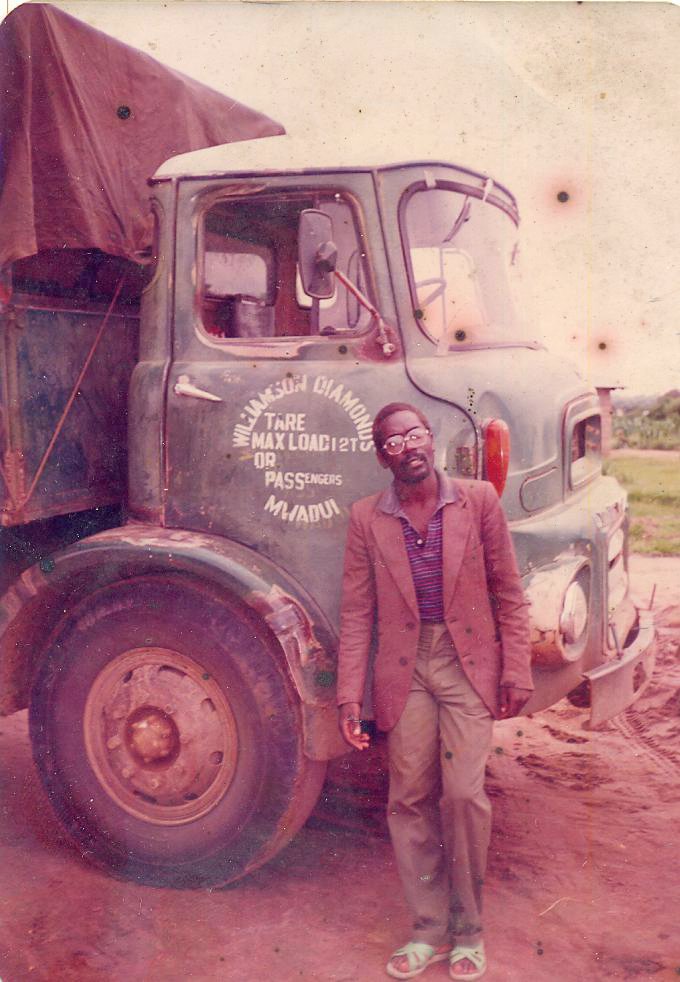
One of the most beautiful things that happened on that tour took place one day when some of us were resting outside a guesthouse, sharing various stories and joking. I don’t remember which town it was, but in the middle of the conversation, a young, beautiful girl appeared and asked for the name of one of our colleagues. Since he was present, he introduced himself happily. Because the girl was very beautiful, our colleague thought he had gotten the luck of being loved by the beauty of the town. He invited that girl to his room, and the girl followed him. But a few minutes later, our colleague came out with his face lit up, and he told us that the girl was his biological daughter. It turns out this musician had passed through that town with another band sixteen years earlier and had slept with a girl, their relationship had resulted in a pregnancy. That pregnancy was our visitor. Due to communication difficulties, the mother had not been able to contact the other parent again, but the mother had been following the life of her former lover through newspapers and radio. When she found out he had come to that town again, she sent her daughter with a letter to introduce herself. The father and his daughter were all happy to know each other, and they resembled each other greatly; there was no doubt about their relationship. It was a very joyful matter. We made a donation, and our colleague was able to leave some money to the girl’s parents. One month later, the girl arrived in Iringa. To this day, that musician occasionally posts pictures on Facebook with his grandchildren, his daughters’ children.
After that difficult tour, the day finally came to start returning to Iringa. For this journey, the leadership of the Williamson Diamond Mines provided us with a bus, and the journey back to Iringa began. While on the way, I started getting an idea for a song about my female friend whom I met at Williamson Diamond Mines. This girl had brownish teeth, and I decided to call her the girl with diamond teeth. I remember I started composing the following words:
Nimeacha roho yangu Mwadui,
Kwa binti mwenye meno ya almasi,
Nimemwacha mlangoni, akiniaga,
Machozi yakimdondoka ehh,
Naapa nitarudi Mwadui nimchukue binti alimasi
“I have left my heart in Mwadui,
With a girl with diamond teeth,
I left her at the door, seeing me off, tears streaming down,
I swear I will return to Mwadui to take the diamond girl.”
It was around 8 PM when we reached Dodoma. I sang the idea I had in my head to my fellow musician Kasaloo Kyanga. We agreed that when we reached Iringa, we would complete the whole song. Indeed, a few days after arriving in Iringa, we completed the song, and it became one of the favourite songs among our fans.
As was customary at that time, before recording new songs in the Radio Tanzania studios, it was mandatory to send the song lyrics for review by a censorship committee, which had the power to allow or stop a song from being recorded. My song ‘Binti Almasi’ (Diamond Girl) was one which was not allowed to be recorded. Believe me were told the reason for that decision was the line that said, “I swear I will return to Mwadui to take the diamond girl,” which was seen as encouraging people to go steal diamonds in Mwadui mines!!!!!!!
.